Tuesday, July 30, 2013

Microsoft Announces White Spaces Pilot in South Africa

Redmond-based software giant Microsoft has announced a new white spaces initiative in Africa, the third of the kind, aimed at delivering low-cost broadband services.

The first such pilot kicked off in Kenya earlier this year as part of the 4Afrika initiative, but the company has already expanded it to Tanzania, and now to South Africa.

The program is aimed at finding new means to provide broadband Internet connectivity at a lower cost to people in this region. White spaces refers to unused frequencies for television broadcasters, which can be harvested to deliver such services to users.

As ZDnet notes, Microsoft has already unveiled plans to make use of such white spaces and solar-based stations so as to offer cheap wireless services to five schools in the Limpopo province in South Africa.

Furthermore, the company is said to plan more than simply offering such services, and that it will also bring Windows-based tablets and projectors to these schools, while offering laptops and training to teachers there. Solar panels to offer power sources for charging devices will also be available.

?Technology holds enormous potential for many aspects of development, but it is particularly key to areas such as education and healthcare,? Mteto Nyati, managing director of Microsoft South Africa, said.

?Reducing the cost of broadband access means millions more South Africans will get online. This will create new opportunities for education, healthcare, commerce and the delivery of government services across the country.?

The project is aimed at offering wireless services for as low as $2-$5 (?1.5 ? ?3.75) per month, for 4Mbps of uncapped usage. At the moment, ISPs charge for around $35 (?26) per month for 1Mbps ADSL services.

Nyati also confirmed plans to make similar white space broadband available for users in other areas, through a partnership with an established ISP provider.

?We see ourselves as an enabler, not a provider. We are not in the telecoms space. I don't think you'll see us becoming a network provider,? he concluded.

Source: http://news.softpedia.com/news/Microsoft-Announces-White-Spaces-Pilot-in-South-Africa-371839.shtml

sylvia plath whitney houston autopsy results obama trayvon jim yong kim michael bush the host trailer whitney houston cause of death

Sunday, July 28, 2013

Jonnie Peacock suffers shock defeat in London as Paralympic champion only finishes third

Peacock beaten by major rivals in London
Not this time: Peacock missed out on his return to the Olympic Stadium (Picture: PA)

Jonnie Peacock suffered a shock defeat in the T43/44 100metres at the London Anniversary Games.

The new world champion was beaten into third place by rivals Alan Oliveira, who set a new world record of 10.57seconds, and Richard Browne, who had beaten Peacock?s previous world record during the week in Lyon.

Peacock looked tired after his exertions at the IPC world championships, where he beat adversary Browne of the USA to the T44 crown.

Brazilian Oliveira is in the T44 class so does not normally face Peacock but set an amazing new world mark at the Olympic Stadium.

Only two of the nine runners failed to set a personal best in what was a lightning-quick race.

Peacock, although third, knocked a hundredth of a second off his own PB.

However, he will not be too disappointed having added the world title to his Paralympic crown in midweek.

MORE: Hannah Cockcroft to attempt double in Rio

MORE: Alan Oliveria sets new 200m world record in Lyon ? then proposes to girlfriend

Source: http://metro.co.uk/2013/07/28/jonnie-peacock-suffers-shock-defeat-in-london-as-paralympic-champion-only-finishes-third-3901858/

split pea soup recipe the client list yahoo.com/mail baylor april 9 albatross louis oosthuizen

Sunday, July 7, 2013

Boeing 777 crashes while landing at San Francisco airport

The fiery crash landing of a Korean jetliner at the San Francisco International Airport late Saturday morning has left at least two people dead, and up to 70 injured, according to NBC Bay Area station KNTV. Hospitals say some of the injured are critical. NBC's Lester Holt reports.

By Erin McClam and Daniel Arkin, NBC News

A Boeing 777 jetliner with 307 people on board crashed and caught fire at San Francisco International Airport on Saturday after a flight across the Pacific Ocean from South Korea. Two people were killed and scores injured, authorities said.

The plane, Asiana Airlines Flight 214 from Seoul, apparently hit the lip of the seawall that separates the runway from San Francisco Bay, sources told NBC News, then slammed into the ground and skidded down the runway before coming to rest in an adjacent field, its tail sheared off and the fuselage spewing black smoke. Photos and video from the scene showed passengers sliding down the emergency chutes and walking away.

Despite the deaths and scores of injuries -- many of them serious -- San Francisco Mayor Edwin Lee said at a evening news conference that "This could have been much worse."


Federal investigators said it was too early to determine a cause.?A representative of the National Transportation Safety Board arrived on scene late Saturday and took control of the investigation.

The sources who spoke with NBC News said the pilot did not make a distress call before landing. The plane crashed in favorable weather ? partly cloudy skies and light wind.

Joanne Hayes-White, the San Francisco fire chief, said there were 307 people on board ? 291 passengers and 16 crew -- and all had been accounted for. Authorities said 182 people were taken to one of nine Bay Area hospitals, including 49 with serious injuries. Hospitals reported that the injuries included burns and fractures.

San Francisco Mayor Edwin Lee thanks the first responders of the Asiana Airlines crash and says "this could have been much worse."

She said first-responders who arrived at the jet saw a handful of survivors emerging from the bay.

?We did observe some of the passengers coming out of the water. But the plane certainly was not in the water. There was a fire on the plane, so the assumption might be that they went near the water?s edge which is very shallow to maybe douse themselves with water.?

The bodies of the two people who were killed were found on the runway, according to Hayes-White.

South Korea's transport ministry said the two who died were Chinese citizens.

Benjamin Levy, who was on the plane, described hearing a lot of screaming after the landing. He told NBC Bay Area that he also saw many head injuries, but that most of the passengers appeared to make it off the plane safely. Fire crews sprayed water and retardant foam to douse the flames.

?We were approaching perfectly well, but we were too low,? he said. ?When the pilot realized it, he put some more gas to correct it, but it was too late, so we hit the runway pretty bad, and we started going up in the air again, and we landed pretty hard.?
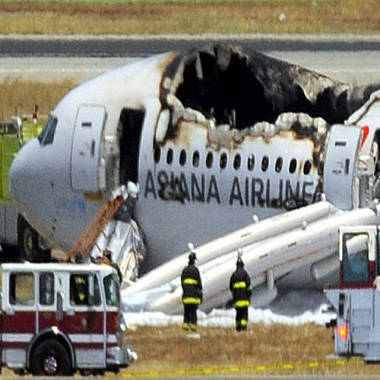
Josh Edelson / AFP - Getty Images

A Boeing 777 operated by Asiana Airlines crash landed at San Francisco International Airport.

Stefanie Turner, a witness, told MSNBC that she saw the plane clip the runway with its tail, then come to rest with flames and smoke billowing from the fuselage.

?The tail was too low. Instead of coming in flat it was coming in at, I would say, maybe a 45-degree angle, with the tail far too low,? she said. ?It really went through quite a few acrobatics on the runway.?

Besides the 61 Americans, the airline said the jet carried 77 Koreans, 141 Chinese, three passengers from India, one each from Japan and Vietnam and seven whose nationalities were unknown.?

The crash ? the first involving a jumbo jet in the United States in more than a decade ? happened at 11:27 a.m. local time. It left a field of debris down the runway, beginning at the seawall that divides the runway from San Francisco Bay. Pieces of the tail could be seen among the wreckage.

An air traffic control recording captured a controller saying: ?Emergency vehicles are responding. We have everyone on the way.?

David Eun, an executive with Samsung Electronics who was on the flight, posted to his Twitter account: ?I just crash landed at SFO. Tail ripped off. Most everyone seems fine. I?m ok.? He also posted a photo that showed people walking or running away from the downed plane, including at least a half-dozen who appeared to have slid down an emergency chute.

Eun previously worked at Google and AOL. Sheryl Sandberg, a friend of his and the chief operating officer of Facebook, said that she was supposed to be on Asiana 214 with family and colleagues but that they switched to a different airline to use frequent-flier miles.

The airline said on Twitter that it was investigating and would have news as soon as possible. It offered thoughts and prayers for the passengers and crew.

The deaths are the first in an accident involving a 777, a wide-body, twin-engine jet that has been in service since 1995 and is known as the Triple-7. Before Saturday, the most serious 777 accident was in January 2008, when a British Airways flight landed short and skidded onto the runway, injuring 47 people. The jet in Saturday?s crash had been in service since 2006.

San Francisco International suspended all takeoffs and landings for four hours after the crash and said that some flights were being diverted. Two of its four runways later reopened. The airport advised passengers to check with their airlines.

President Barack Obama, at the Camp David retreat in Maryland, was made aware of the crash and was in touch with federal, state and local authorities, a White House official said.

The last crash of a jumbo jet in the United States was in November 2001, when American Airlines Flight 587, an Airbus A300-600 airliner,?crashed in a New York neighborhood. The last fatal crash of any commercial plane in the U.S. was in February 2009, when a Continental Airlines regional flight crashed into a house near Buffalo, N.Y., killing 49 people.

The flight tracking service FlightAware said that Asiana 214 flew about 10 and a half hours after taking off from Incheon airport at 5:04 p.m. local time, about half an hour late. The flight had originated in Shanghai, China.

The service identified the model as a Boeing 777-200, which has a wingspan of almost 200 feet and can carry as many as 440 people. The manufacturing company Pratt & Whitney said the plane was powered by its PW4000 engines.

Federal sources told NBC News that there was no indication of terrorism. The National Transportation Safety Board said it was sending a full team to San Francisco. Boeing said it was gathering information.

?Our thoughts are with everyone affected by today?s incident at SFO,? Boeing said on its Twitter account. ?We stand ready to assist the NTSB.?

Jay Blackman, Jonathan Dienst, Richard Esposito, Tracy Jarrett and Kristen Welker of NBC News contributed to this report. The Associated Press also contributed.

This story was originally published on

Source: http://feeds.nbcnews.com/c/35002/f/663306/s/2e4cc960/l/0Lusnews0Bnbcnews0N0C0Inews0C20A130C0A70C0A60C193235410Eboeing0E7770Ecrashes0Ewhile0Elanding0Eat0Esan0Efrancisco0Eairport0Dlite/story01.htm

mitch hedberg secret service scandal shea weber greystone sidney crosby at the drive in alternative minimum tax

Tuesday, July 2, 2013

New treatment for schizophrenia discovered in Finland

New treatment for schizophrenia discovered in Finland [ Back to EurekAlert! ] Public release date: 1-Jul-2013
[ | E-mail | Share Share ]

Contact: Jesper Ekelund
jesper.ekelund@helsinki.fi
358-503-317-987
University of Helsinki

A research group led by professor Jesper Ekelund showed that by giving a very large dose of famotidine (200 mg daily), sufficient amounts of the drug are able to penetrate the so-called blood-brain barrier to affect the histamine system in the brain.

Famotidine has been used for the treatment of heartburn since the 1980s, but at regular dosing, famotidine almost does not enter the brain at all, since the brain is protected by the blood-brain barrier. By increasing the dosage five-fold the drug is able to enter the brain and affect the histamine system.

- Already after one week the symptoms of persons suffering from schizophrenia started to decrease and after four weeks of treatment the symptoms had decreased statistically significantly. The patients that participated in the study were also positively disposed towards the treatment, says Ekelund.

Thirty persons suffering from schizophrenia participated in the study. The patients had been on sickness pension for at least five years. They were randomly divided into two groups, one which received famotidine and one which received placebo. All of the patients who took famotidine responded positively to the treatment while the symptoms of those who were on a placebo did not change.

Schizophrenia is the most common and severe psychotic disorder, and is the cause of at least half of all psychiatric hospital treatment days. No randomized, controlled trials in humans that test the effect of H2 blockade in schizophrenia have been published so far.

Innovation in psychiatric medication urgently needed

Since 1963, when the subsequent Nobel prize winner Arvid Carlsson showed that dopamine has a central role in psychosis, the so called dopamine-hypothesis has been central in psychosis. All presently available medications for psychosis are based around this principle. Since treatment response is all too often incomplete and side effects common, there is still a great, unmet medical need for medications with other mechanisms of action. Many other signaling substances have been the focus of attention, but so far, the brain histamine system has most widely been regarded as important only with regard to side effects of many psychosis medications.

- Famotidine shouldn't be used directly as treatment for schizophrenia until long-term use of a dose of this size has been proved safe. However, our study shows that the histamine system in the brain offers a novel approach to treating psychosis. This should lead to increased efforts by the pharmaceutical industry to develop medications based on this histamine-based mechanism, says Ekelund.

Famotidine works by blocking the histamine H2 receptor. There are important neurons in the brain that use histamine as their primary signaling substance. These neurons have an important role as regulators of other signaling substances. From animal research, it is known that by affecting the histamine system, one can also affect other signaling substances that are known to be involved in schizophrenia.

The project has already received international recognition. Katarina Meskanen, one of the members of Ekelunds research group, was awarded the Young Scientist Award of the SCNP (Scandinavian College of Neuropsychopharmacology) and the project has been awarded substantial funding (306,000 USD) from the Stanley foundation for follow-up studies.

###

The research group will replicate the finding through a larger, multinational study in collaboration with Karolinska Institutet in Sweden, where the study is coordinated by professor Jari Tiihonen.


[ Back to EurekAlert! ] [ | E-mail | Share Share ]

?


AAAS and EurekAlert! are not responsible for the accuracy of news releases posted to EurekAlert! by contributing institutions or for the use of any information through the EurekAlert! system.


New treatment for schizophrenia discovered in Finland [ Back to EurekAlert! ] Public release date: 1-Jul-2013
[ | E-mail | Share Share ]

Contact: Jesper Ekelund
jesper.ekelund@helsinki.fi
358-503-317-987
University of Helsinki

A research group led by professor Jesper Ekelund showed that by giving a very large dose of famotidine (200 mg daily), sufficient amounts of the drug are able to penetrate the so-called blood-brain barrier to affect the histamine system in the brain.

Famotidine has been used for the treatment of heartburn since the 1980s, but at regular dosing, famotidine almost does not enter the brain at all, since the brain is protected by the blood-brain barrier. By increasing the dosage five-fold the drug is able to enter the brain and affect the histamine system.

- Already after one week the symptoms of persons suffering from schizophrenia started to decrease and after four weeks of treatment the symptoms had decreased statistically significantly. The patients that participated in the study were also positively disposed towards the treatment, says Ekelund.

Thirty persons suffering from schizophrenia participated in the study. The patients had been on sickness pension for at least five years. They were randomly divided into two groups, one which received famotidine and one which received placebo. All of the patients who took famotidine responded positively to the treatment while the symptoms of those who were on a placebo did not change.

Schizophrenia is the most common and severe psychotic disorder, and is the cause of at least half of all psychiatric hospital treatment days. No randomized, controlled trials in humans that test the effect of H2 blockade in schizophrenia have been published so far.

Innovation in psychiatric medication urgently needed

Since 1963, when the subsequent Nobel prize winner Arvid Carlsson showed that dopamine has a central role in psychosis, the so called dopamine-hypothesis has been central in psychosis. All presently available medications for psychosis are based around this principle. Since treatment response is all too often incomplete and side effects common, there is still a great, unmet medical need for medications with other mechanisms of action. Many other signaling substances have been the focus of attention, but so far, the brain histamine system has most widely been regarded as important only with regard to side effects of many psychosis medications.

- Famotidine shouldn't be used directly as treatment for schizophrenia until long-term use of a dose of this size has been proved safe. However, our study shows that the histamine system in the brain offers a novel approach to treating psychosis. This should lead to increased efforts by the pharmaceutical industry to develop medications based on this histamine-based mechanism, says Ekelund.

Famotidine works by blocking the histamine H2 receptor. There are important neurons in the brain that use histamine as their primary signaling substance. These neurons have an important role as regulators of other signaling substances. From animal research, it is known that by affecting the histamine system, one can also affect other signaling substances that are known to be involved in schizophrenia.

The project has already received international recognition. Katarina Meskanen, one of the members of Ekelunds research group, was awarded the Young Scientist Award of the SCNP (Scandinavian College of Neuropsychopharmacology) and the project has been awarded substantial funding (306,000 USD) from the Stanley foundation for follow-up studies.

###

The research group will replicate the finding through a larger, multinational study in collaboration with Karolinska Institutet in Sweden, where the study is coordinated by professor Jari Tiihonen.


[ Back to EurekAlert! ] [ | E-mail | Share Share ]

?


AAAS and EurekAlert! are not responsible for the accuracy of news releases posted to EurekAlert! by contributing institutions or for the use of any information through the EurekAlert! system.


Source: http://www.eurekalert.org/pub_releases/2013-07/uoh-ntf070113.php

time 100 bob beckel anna paquin warren buffett 2012 nfl schedule dishonored april 18